OpenClassrooms · Companion
Why learners weren't talking to their AI companion
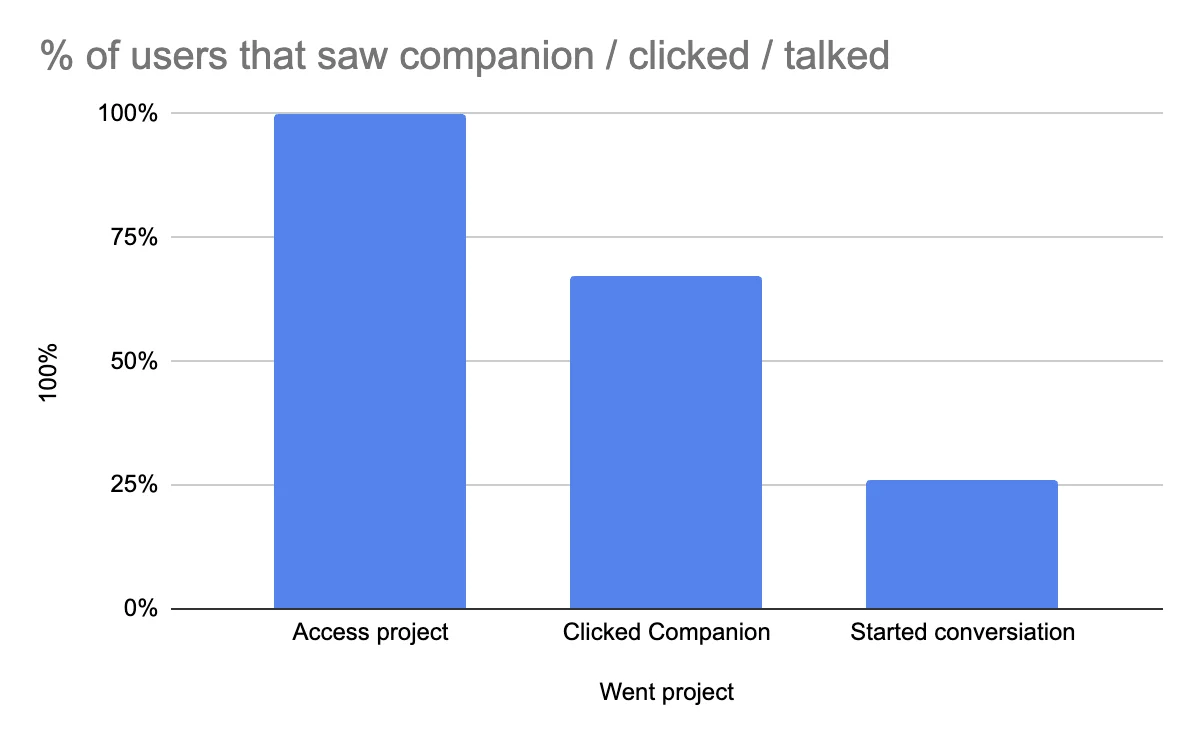
67% of learners opened Companion, but only 27% started a conversation. My research showed why, and convinced OpenClassrooms to keep investing in it instead of shelving it.
Overview
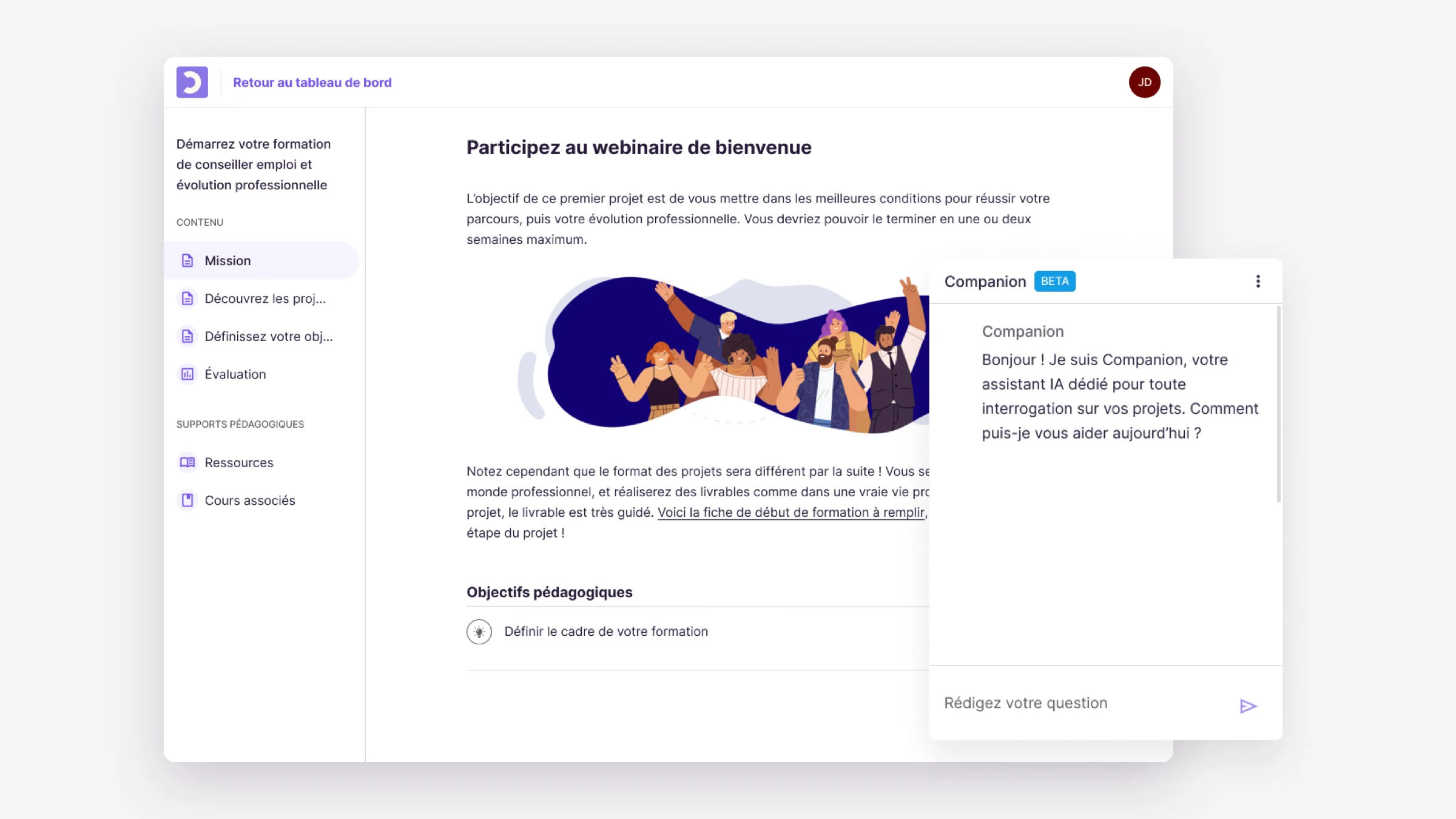
Companion is OpenClassrooms' AI assistant, built into every project so learners can get help with the context of their own work. It launched on all paths in July 2024. A week later, usage was already falling. I led the investigation into why, and turned it into a new direction for the product.
Details
- Surface
- Web learning platform, project page
- Role
- Senior Product Designer, Learning squad
- Team
- 1 designer (me) · 1 PM · 1 PO · 2 front-end devs · 2 back-end devs
- Scope
- Product analytics · Survey design · Research synthesis · Strategic vision
Problem
Seen by everyone, used by few
Nearly every learner saw Companion, and two thirds clicked on it. But only about one in four ever sent a message, and weekly usage kept falling.
Solution
Reframing the problem
Through analytics, session recordings and a survey of 173 learners, I showed the issue wasn't visibility or usability, but value: learners didn't see why they should use Companion rather than ChatGPT.
Result
Doubling down on context
The research convinced OpenClassrooms to keep investing in Companion instead of shelving it. The findings set the direction for what Companion should become: lean into what ChatGPT can't offer, an assistant that knows the project, OpenClassrooms' grading expectations, and can read the learner's own deliverables.
Impact
67% 27%
of learners clicked on Companion, but only 27% started a conversation
58%
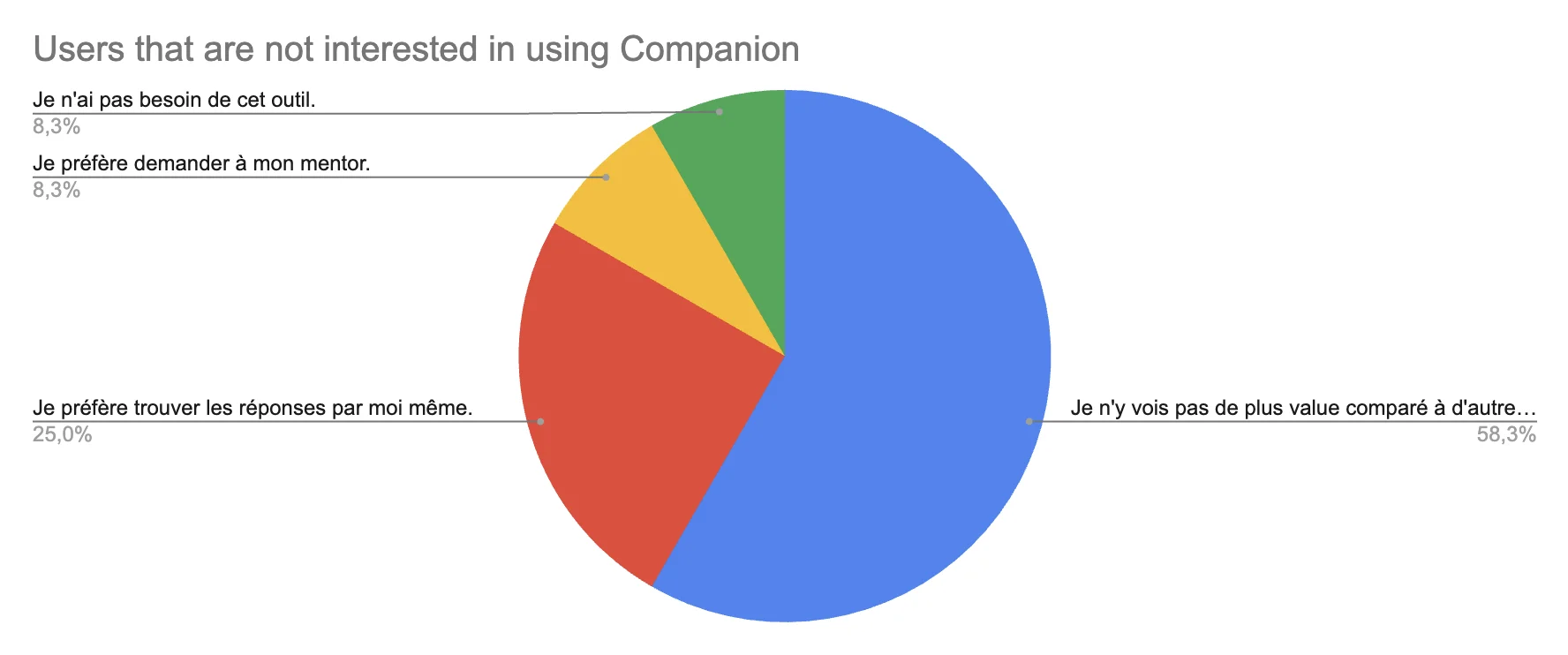
of uninterested learners saw no added value compared to other AI tools
173
learners surveyed, alongside Amplitude, Tableau and Hotjar data
Context
Companion was designed to know each project's brief and expectations, something a general-purpose chatbot can't offer.
OpenClassrooms trains adults through online, career-focused degree programs built around real projects, with a human mentor for regular one-on-one sessions.
After launching on all paths on July 8, 2024, early data showed a clear lack of usage.
Goals
Understand why learners weren't using Companion.
- Separate the easy explanations (they can't find it, it's hard to use) from the harder ones (they don't need it).
- Give the squad evidence it could act on.
Process
I combined four sources over the first five weeks after launch.
Amplitude & Tableau
Tracked the funnel from project page to first message, and weekly retention.
Hotjar recordings
Checked for access and usability problems.
Survey, 173 answers
A survey I designed on usage, satisfaction, reasons for not using it, and comparison with other AI tools.
I also flagged the limits of the data, since the launch fell during the summer holidays.
Key insights
Insight 01
It wasn't a visibility or usability problem.
67% of learners who opened a project page clicked on Companion, and most rated it easy to use. The real drop happened between opening it and asking a first question: only 27% started a conversation.
Insight 02
Companion was competing with ChatGPT, and losing on trust.
90% of learners already knew another AI tool. Learners did understand Companion's one edge (21 of them named its knowledge of the project), but many still found ChatGPT more reliable.
Insight 03
It never became part of the learning routine.
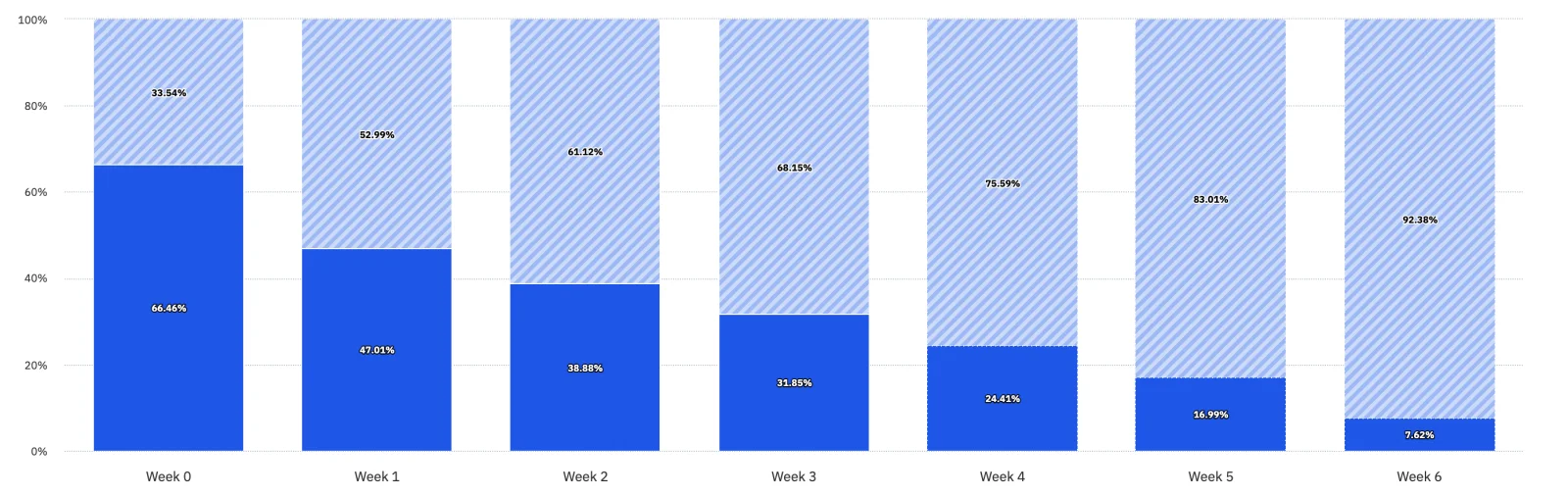
Learners saw Companion around 36 times on average but used it on only 5% of those occasions. More than half stopped by their third week.
Insight 04
Showing works better than telling.
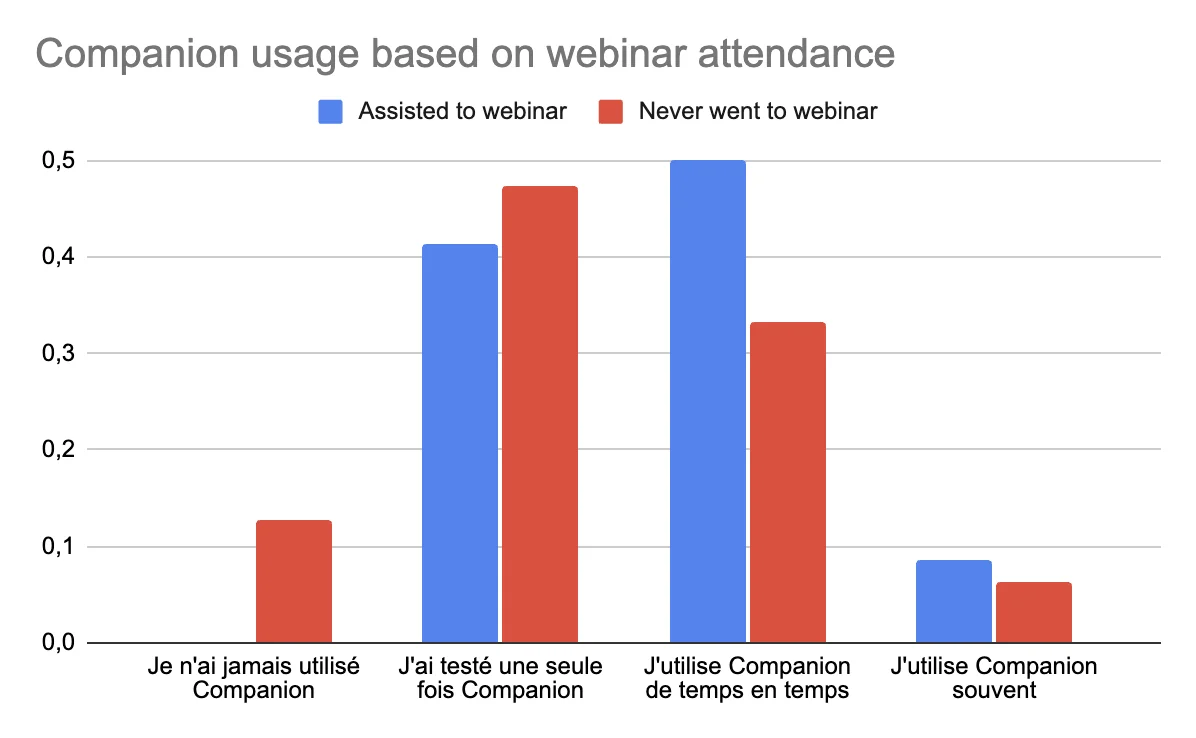
Learners who attended a webinar demonstrating Companion were more likely to try it and to keep using it. A strong value proposition wasn't enough on its own; learners needed concrete use cases.
Recommendations
From these insights, I proposed five directions.
- Show concrete use cases in the chat and dashboard.
- Fix bugs and give Companion richer project context.
- Re-introduce it at each new project rather than only the first.
- Measure answer accuracy.
- Make Companion proactive on the problems learners most often face in a given project.
Where it could go next
Three directions I sketched from the recommendations, each answering one insight.
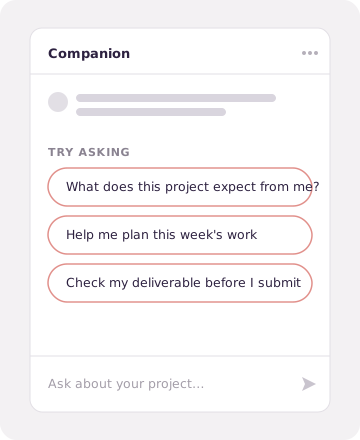
Give a reason to start
Suggested questions turn an empty chat into concrete use cases, like the webinar did for attendees.
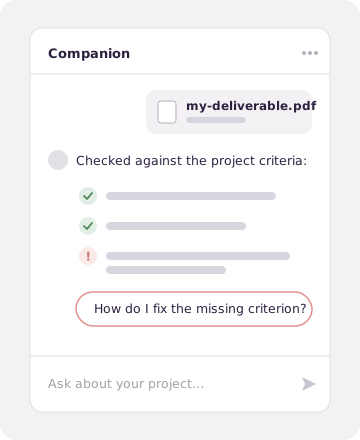
Do what ChatGPT can't
Companion reads the learner's deliverable and checks it against the project's grading criteria.
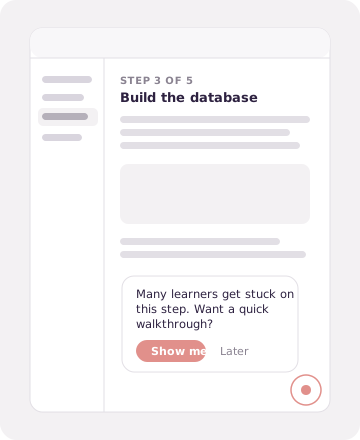
Show up at the right moment
Companion reaches out on the steps where learners most often get stuck, so it becomes part of the routine.
These are low-fidelity explorations, not shipped designs.
Reflections
Awareness isn't adoption.
A feature everyone sees can still fail; the real question is the first meaningful interaction.
An AI feature competes with the best AI the user already has.
The bar isn't "useful", it's "more useful than ChatGPT", and the only durable edge is context the general tool can't access.
Start from the need, not the capability.
Companion launched as an open chat that could answer anything, which left learners to work out what it was for. The strongest directions start from a moment they already struggle with, like checking a deliverable before submitting it.
What I'd do next
I'd put these three directions in front of learners before building anything, starting with deliverable review since it's the clearest edge over ChatGPT. I'd pilot it on one path and track a single number: how many learners who open Companion go on to send a first message, the drop the research pinned down.
In parallel, I'd set up a way to rate answer accuracy, so trust can be measured rather than guessed from surveys.